Dienstag, 3. Juli 2018

Water Lily

Yes, I have more potholders and washcloths than any sane person could reasonably want. But I think - as small knitting projects go - they are great to try out shaping ideas and techniques. And the techniques that are used here are short rows and weaving in yarn (not ends!) while knitting. Other than that you only need to be able to do garter stitch.

These washcloths make great presents, e.g. to accompany a spa set. But you can also use the pieces as potholders or coasters.


Creative Commons License
This work by Knitting and so on is licensed under a Creative Commons Attribution-NonCommercial-ShareAlike 4.0 International License.



An Arabic video tutorial for this pattern has been provided by Ma_Yarns: it is available here.


Materials
  • about 25 to 35 grams of DK weight cotton yarn in two colors - called CC (contour color) and MC (main color)
  • 3.5mm knitting needles
  • (a stitch marker)
  • a tapestry needle to weave in ends

Techniques
  • Short rows with wrap and turn (w+t) - as shown in this YouTube video by Very Pink Knits. Since this washcloth is knit in garter stitch, you don't have to pick up your wraps - except in two rows, i.e. the rows where the wrapping color is different from the color of the wrapped stitch. These rows are indicated in the pattern. Here's a YouTube video that shows how to pick up your wraps (also by Very Pink Knits).
  • Knitted Cast-On: See this Youtube-video by Very Pink Knits.
    A tutorial for the knitted cast-on that uses this (Water Lily) pattern has been written by Christina Garza-Brown and can be found here at knitfarious.com
  • Weaving in yarn while knitting - carrying it towards the end of the row: This technique (and the next) are used to avoid a long float that runs parallel to your knitting - and to avoid cutting your yarn. When starting with the contour color yarn (lilac in the photos) before knitting a stitch you put the main coloryarn (white in the photos) over the contour color yarn (see illustration 1 below), then you knit the stitch. Before knitting the next stitch you twist the yarns again (see illustration 2). If you repeat these steps you can carry the yarn over a chosen number of stitches- so that it looks neat on WS (see illustration 3 below).
    A similar technique (to weave in ends) is shown in this YouTube video by So, I make stuff
  • Weaving in yarn while knitting - towards the beginning of a row: This technique is similar to the one explained before and it serves the same purpose. You draw a long loop of the "new" yarn to the point where you want to knit it (picture 1). This gives you a really long float. Knit the first stitch. Before knitting the second stitch, catch the float by put the left hand needle under the float (picture 2) and then knit the stitch with your working yarn as usual. If you catch the float every second stitch, the WS will look as shown in picture 3. (This is a bit like catching floats in stranded knitting as shown in this YouTube video by Knit Purl Hunter.)

In case the last two techniques are too fiddly, you can alternatively cut the yarn of the main color after each petal and weave in the ends.


Size
One piece - as knitted by me - is about 29 cm wide and 15 cm high.


Construction
Petals constructed of short rows and contour lines in a contrast color. It consist of five big petals and four small ones. The first two big petals are shaped in a way that they have a small "cut out" at the left side. The middle petal is symmetrical, and the last two big petals are shape mirror-inverted to the first two. Between two big petals there is a small petal. This is shown below.


After each petal - when knitting the contour lines, you bind off 8 stitches, and then you cast them on again. After doing this, you should carry the main color yarn first back to the beginning of the row.
The picture below shows how this looks on the WS of the piece. Alternatively you can cut the yarn of the main color after each petal and weave in the ends.


It may be helpful to place a stitch marker after the 9th stitch. This means when binding off, you don't have to count but the 8 stitches to BO, but only have to BO up to the stitch before the marker.
I knitted the first washcloth without a stitch marker and sometimes left track of how many stitches I had already bound off. So I used a stitch marker for the second washcloth which worked well with regards to counting. But while knitting the petals the stitch marker got in the way, so I took it out again.


Instructions

CO32 in CC
Setup Row: k all

Right Petal
When starting to knit a petal, you slip the first two stitches - they are knitted only in CC to achieve a contour.

In MC
Ridge 1: sl2, k28, w+t, k26, w+t
Ridge 2: k24, w+t, k22, w+t
Ridge 3: k20, w+t, k18, w+t
Ridge 4: k16, w+t, k14, w+t
Ridge 5: k12, w+t, k10, w+t
Ridge 6: k8, w+t, k9, w+t
Ridge 7: k6, w+t, k8, w+t
Ridge 8: k6, w+t, k8, w+t
Ridge 9: k6, w+t, k8, w+t
Ridge 10: k22, w+t, k25, sl2

Long Contour 
In CC
Row 1: sl1, k to end (carrying MC for the first 8 sts)
Row 2: sl1, k to 1 bef end, sl1
Row 3: BO8, w+t
Row 4: k1, CO8 with knitted cast on
Row 5: sl1, k8, k1tbl, k1, w+t
Row 6: k to end

Small Petal
In MC
Ridge 1: sl2, k14 (while carrying MC from the 8th stitch back to the 2nd stitch), w+t, k12, w+t
Ridge 2: k10, w+t, k8, w+t
Ridge 3: k6, w+t, k4, w+t
Ridge 4: k3, w+t, k4, w+t
Ridge 5: k6, w+t, k8, w+t
Ridge 6: k10, w+t, k13, sl2

Short Contour 
In CC
Row 1: sl1, k16, w+t  (carrying MC for the first 8 sts)
Row 2: k to last st, sl1
Row 3: BO8, w+t
Row 4: k1, CO8 with knitted cast on
Row 5: sl1, k8, k1tbl, k1, w+t
Row 6: k to end

Knit
- a right petal (while carrying MC from the 8th stitch back to the 2nd stitch in Ridge 1)
- a long contour
- a small petal
- and a short contour

Middle Petal
In MC
Ridge 1: sl2, k28  (while carrying MC from the 8th stitch back to the 2nd stitch), w+t, k26, w+t
Ridge 2: k24, w+t, k22, w+t
Ridge 3: k20, w+t, k18, w+t
Ridge 4: k16, w+t, k14, w+t
Ridge 5: k12, w+t, k10, w+t
Ridge 6: k9, w+t, k10, w+t
Ridge 7: k12, w+t, k14, w+t
Ridge 8: k16, w+t, k18, w+t
Ridge 9: k20, w+t, k22, w+t
Ridge 10: k24, w+t, k27, sl2

Knit
- a long contour
- a small petal
- a short contour

Left Petal
In MC
Ridge 1: sl2, k25  (while carrying MC from the 8th stitch back to the 2nd stitch), w+t, k23, w+t
Ridge 2: k8, w+t, k6, w+t
Ridge 3: k8, w+t, k6, w+t
Ridge 4: k8, w+t, k6, w+t
Ridge 5: k9, w+t, k7, w+t
Ridge 6: k10, w+t, k11, w+t
Ridge 7: k13, w+t, k15, w+t
Ridge 8: k17, w+t, k19, w+t
Ridge 9: k21, w+t, k23, w+t
Ridge 10: k25, w+t, k28, sl2

Knit
- a long contour
- a small petal
- a short contour
- a left petal

Last Ridge
in CC
Row 1: sl1, k all
Row 2: BO all

Cut yarns, weave in ends.
I used the tail to sew the little hole between the first and last petal closed.


Montag, 25. Juni 2018

Bella Paquita

Bella Paquita is a beautiful free sweater pattern by Marnie MacLean - available via Ravelry or directly on her website. I discovered it in my early Ravelry days (in 2011) and wanted to knit it right then, even though I wasn't a good knitter back then and lacked some of the skills necessary for it.


I even bought a beautiful and quite expensive (at least I thought so at the time :) grey alpaca yarn for it, but I was a bit too afraid to use it. So I first tried the pattern with some really old old bordeaux red yarn from a sweater I had started in the 1980s and frogged (here's the Ravelry page of the project). I made quite a few mistakes when knitting it for the first time - some due to my lack of knitting experience other due to not reading the pattern :/

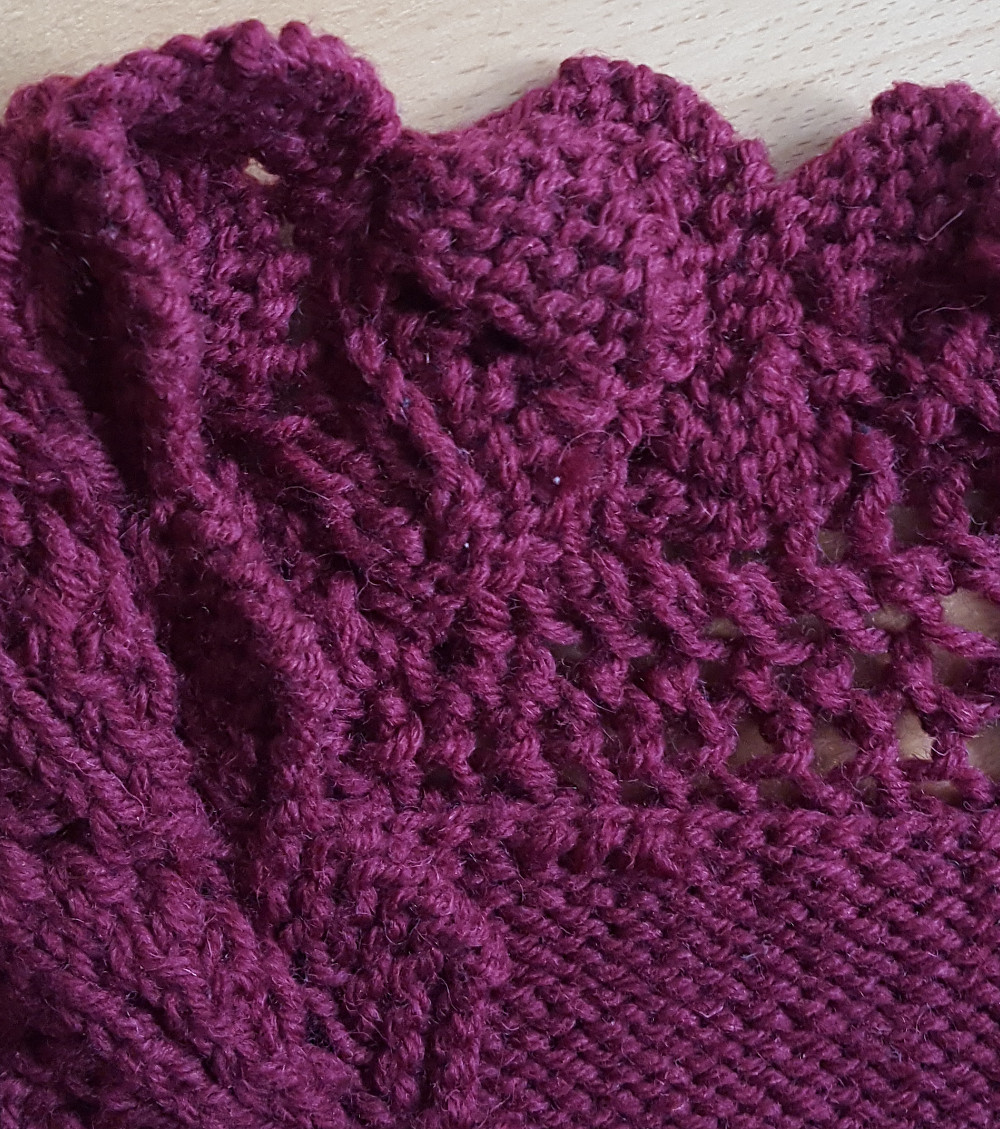
But I finished it and really liked the look of it - except for the curve of the lace collar. To make the lace collar fit, the pattern suggests: "to sew two small darts in the lace" and later after you've sewn it with your sewing machine to "clip the excess fabric about a quarter inch from the outer most seam line". Cutting into my knitting is something that I don't think I could ever do. So when I knitted the first one, I just sewed the collar to lay flat on my shoulders, but I didn't cut the excess. The picture on the right shows how that looked from the inside.

So I resolved to use to use short rows to shape the collar - when knitting it again with my beautiful alpaca yarn. A project that I started soon after finishing the first sweater. I quickly did the main pieces (front, back and sleeves) - and then started the lace. It took me a few attempts to get a) the short rows and b) the curve right, but I guess I got it right in December 2012. And I know I knitted a piece of the collar on the train home after New Year's Day of 2013.

And then it became a WIP - a hibernating WIP. For a loooong time ...

I don't even know why I abandoned it, but this year (more than 5 years later, when I was going through a bit of an inspirational crisis :) I finally picked it up again and
  • finished the lace collar (even though I had to try the lace pattern with the short rows a few times with scrap yarn)
  • sewed up the pieces and
  • inserted the lace collar.
It was finished (fireworks!), and I'm really happy with it ...

As it may help somebody else who also wants to knit this lovely sweater, here are the modifications I did. More photos can be seen on my Ravelry project page.

Firstly, I didn't knit the pieces in the order as given in the pattern. I started from the hip and knitted the front and back piece together in the round. After ribbing, I put 12 stitches (in the middle of the front part on a stitch holder (or rather scrap yarn) and started to knit in rows. When reaching the sleeves, I devided it into two front and one back part, that I finished seperately.

But the major modification was knitting the collar in short rows, which I did as follows:
  • Short row (ridge) for regular lace: (RS) k3, yo, p2tog, yo, p2tog, ktbl, turn (just a normal turn, no w+t), (WS) sl1, p1, k2, yo, p2tog, yo, p2tog, k1
    Since this increases the stitch count by 1, in the next row I did a k2tog just over the gap, i.e. the two stitches I knitted together were the last stitch of the short row (RS) and the next stitch. If that next stitch was to be a k2tog (as stated by the lace pattern), I did a k3tog.
  • Short row (ridge) for reverse lace: (WS), k1, p2tog, yo, p2tog, yo k2, p1, turn, (RS) sl1, yo, p2tog, yo, p2tog, k3
    As with the regular lace, this increases the stitch count by one, so I had to decrease by one in the following in row. And I did this also at the gap, where I did a p2tog instead of the normal p (as given in the lace pattern without short rows). 
On both sides (regular and reverse) I first knitted one normal repeat of the lace pattern (A in the picture below). Then 3 repeats with the short rows inserted every 2nd row (B, before rows 1, 3, 5, 7 and 9 for the regular lace and before rows 2, 4, 6, 8 and 10 for the reverse lace). Then one repeat with only two short rows (C, before the 3rd and 7th row for the regular lace, and before the 4th and 8th for the revers). Then I went on with normal pattern repeats (D).


Since I rarely knit sweaters that are sewn up (for my own stuff, I prefer top-down raglan constructions, e.g. this one), I had a hard time inserting the sleeves. On YouTube I found these helpful videos:
This was the first time I actually finished a long term WIP - usually, I tend to frog them.
Do you have a WIP that has been lying around for quite a while? If so, do you think you'll ever finish it?

By the way, the background picture of my blog (the grey knitted ribbing) is a photo of the ribbing of this project :) ... and it has been the background picture for more than five years.

Montag, 18. Juni 2018

Fingerlose Handschuhe "Inbetween Mitts" - Gratis-Strickanleitung

Bernadette von „Törtchens Blog“ hat sich die Mühe gemacht, die Anleitung für die Inbetween Mitts in Deutsche zu übersetzen. Vielen lieben Dank dafür!

Dabei hat sie diverse Fehler und Ungenauigkeiten gefunden, die ich dadurch in der Originalanleitung korrigieren konnte. Solche Kommentare sind äußerst wertvoll und hilfreich für mich - daher bin ich sehr dankbar dafür. Ihre Erfahrungen hat sie in diesem Blogpost beschrieben.

Die deutsche Gratis-Strickanleitung als PDF gibt es hier.
Neben der Übersetzung enthält die Datei auch noch eine zusätzliche Variante von Bernadette für den Teil 3.
(Edit 03.10.2021: Update des Links auf die PDF-Datei, da sich offenbar die Links auf GoogleDrive geändert hatten.)

The (corrected) original pattern in english is available here.
Die (korrigierte) Originalanleitung auf Englisch gibt es hier.


Creative Commons License
This work by Knitting and so on is licensed under a Creative Commons Attribution-NonCommercial-ShareAlike 4.0 International License.