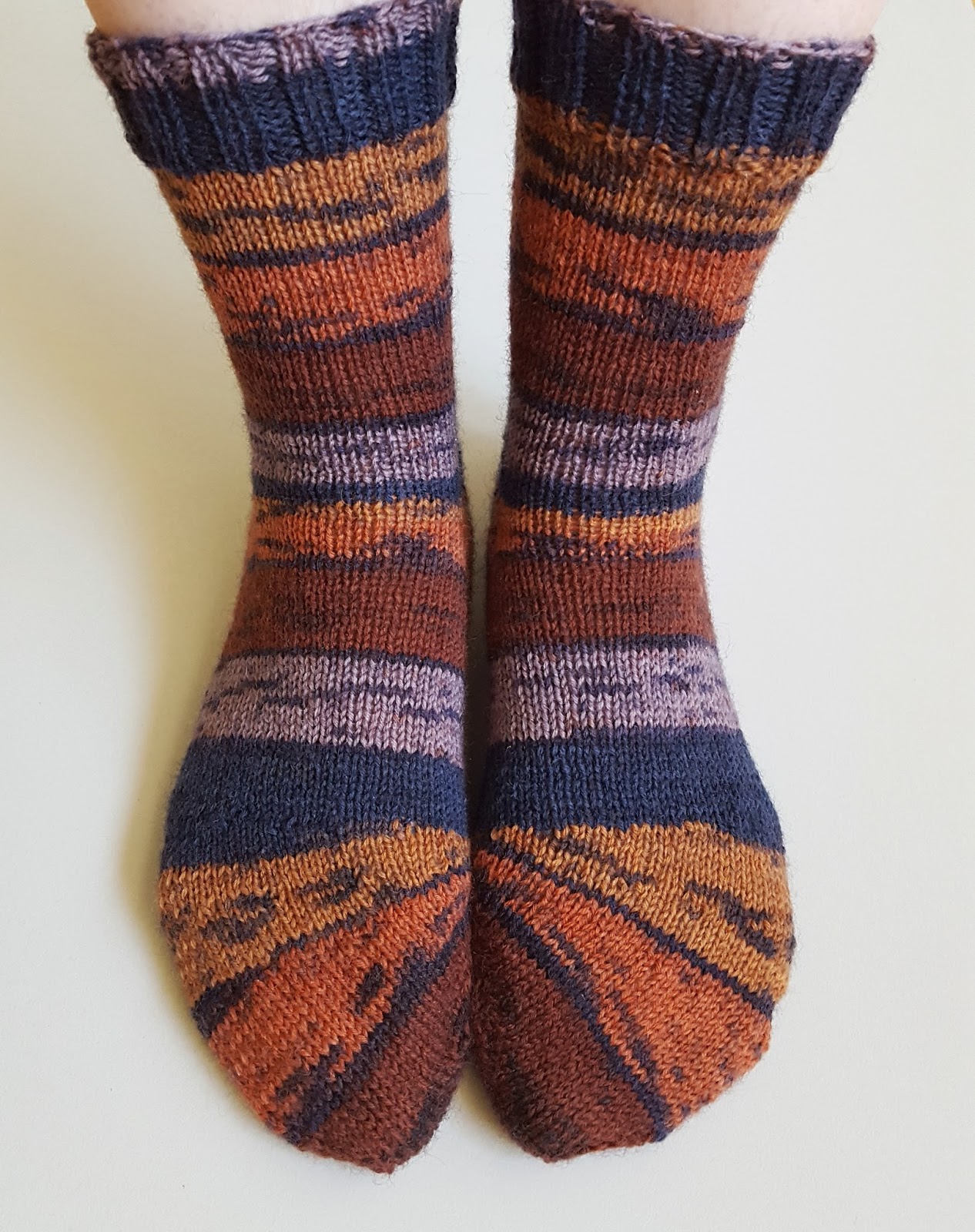
When using self striping sock yarn it's always fun to try different ways of knitting common shapes like sock toes, because the self striping yarn will create attractive patterns. A while ago I had the idea of knitting slanted toes and using short rows to even them out before getting to the heel. I tried and frogged quite a few times before I actually managed to knit something to fit around human feet, but I finally made it.
These socks are knitted from the toe up, but they start at an angle and continuing with short row wedges. This slanted effect shows best with variegated yarn ... it's possible to knit it with a solid yarn, but you won't see the slanted effect. I've used and described a shadow wrap heel, but you can use any toe-up heel you like.
As with many of my patterns, this is not exactly a beginner pattern. It's also helpful, if you've knitted another pair of socks before.
Eine
deutsche Version dieser Anleitung gibt es hier.
A
German version of this pattern is available here.

This work by
Kniting and so on is licensed under a
Creative Commons Attribution-NonCommercial-ShareAlike 4.0 International License.
 Materials
- 50 to 80 grams of fingering weight yarn - depending on how long you like your sock cuff; for the lighter ones (in pastell colors) I used Lana Grossa Meilenweit Special Confetti (color 2508; here's the link to the yarn's Ravelry page) for the darker ones (dark blue, brown, orange etc.) I used Vendita Sockenwolle bought at Aldi's about three years ago (here's a link to the yarn's Ravelry page)
- 2.5mm needles - I used Addi CrasyTrio, but you can use dpns or a circular needle (with Magic Loop method) as well
- 2 different stitch markers - one to mark the end of round (called "end marker") and one to mark the middle of the round (called "middle marker")
- a tapestry needle to weave in ends
Techniques
- Judy's Magic Cast-On is a technique that gives you live stitches on both sides of your needle - it is generally used for toe-up socks (e.g. in this pattern), but it can be used for other purposes as well. Here's a written description (from Knitty) and here's a YouTube-video by Cat Bordhi and another YouTube-video by Very Pink Knits.
- German Short Rows (t+p): when you turn, bring yarn to the front and pull it back so that a sort of double-stitch is created, then knit back as usual - when you have to knit the double-stitch, be careful to knit it as one stitch (see also https://www.youtube.com/watch?v=P6n561SMZXQ); this method has the advantage the no picking up of stitches is necessary. In the pattern, this stitch will be called t+p (turn and pull).
- Shadow Wrap Short Rows - as used for the heel: as shown in this YouTube video by Lee Meredith. A video by Miriam Felton that shows how to do a heel with shadow wraps can be found here on YouTube. However, the heel knitted here is knitted slightly different because here there are two rounds between the two parts of the heel, i.e. there won't be any triple stitches.
Gauge and Sizes
When I knitted these 19 rows of stockinette gave 5cm in height and 16 sts (stockinette) gave 5 cm in width. But If you've knitted socks before, you'll know which total stitch count to aim for. Here's the table that shows you the usual amount of stitches you need for your shoe size. Furthermore, it shows over how many stitches you're going to knit the heel (after some increases) and how these stitches are distributed, i.e. how many stitches are used for short rows at each side.
E.g. for size 36 you work the heel over 34 stitches, i.e. you do short rows for 11 stitches on both sides and 12 stitches in the middle are knitted normally.
| shoe size | total number of stitches | heel stitches (after increasing) | distribution of heel stitches |
|---|
| 32-35 | 56 = 2x28 | 28 + 4 = 32 | 11 - 10 - 11 |
| 36-39 | 60 = 2x30 | 30 + 4 = 34 | 11 - 12 - 11 |
| 40-43 | 64 = 2x32 | 32 + 4 = 36 | 12 - 12 - 12 |
Instructions for sizes are given as follows: sizes 32-35 [sizes 36-39, sizes 40-43]. I.e. the instructions before the brackets are for sizes 32 to 35 and in brackets first for sizes 36 to 39 and then for sizes 40 to 43.
Instructions
First Sock
Toe
Do a magic CO of 2x10 sts [2x10, 2x12]
Round 1: k8 [k8, k10],
kfb k1, place marker ("half marker"), k1
kfb k8 [k8, k10], place marker ("end marker")
Round 2: k1,
kfb, k to 2 bef half marker,
kfb, k1, slip half marker, k1,
kfb, k to 2 bef end marker,
kfb, k1
Round 3: k to 2 bef half marker,
kfb, k1, slip half marker, k1,
kfb, k to end
Repeat rounds 2 and 3 four more times. (Now you have 2x26 [2x26, 2x28] sts on your needles)
For sizes 36-39 and 40-43 repeat round 2 once more.
Now you have 2x26 [2x28, 2x30] sts on your needles
Round 12 [13, 13]: k all
Round 13 [14, 14] = Round 2
Round 14 [15, 15]: k all
Round 15 [16, 16] = Round 3
Now you have 2x29 [2x31, 2x33] sts on your needles (i.e. 1 too much for the stitch count you're actually aiming for) - and the short row wedges will be started.
Wedge 1
Round 16: k to 4 bef half marker, t+p, p to end (and without changing direction) p to 4 bef half marker, t+p, k to end
Round 17: k to 8 bef half marker, t+p, p to end (and without changing direction) p to 8 bef half marker, t+p, k to end
Round 18: k to 12 bef half marker, t+p, p to end (and without changing direction) p to 12 bef half marker, t+p, k to end
Round 19: k to 16 bef half marker, t+p, p to end (and without changing direction) p to 16 bef half marker, t+p, k to end
Round 20: k to 20 bef half marker, t+p, p to end (and without changing direction) p to 20 bef half marker, t+p, k to end
Round 21: k to 24 bef half marker, t+p, p to end (and without changing direction) p to 24 bef half marker, t+p, k to end
Round 22: k1,
ssk, k to 3 bef end marker,
k2tog, k1
Round 23: k to 2 bef half marker,
kfb, k1, slip half marker, k1,
kfb, k to end
Wedge 2
Round 24: k to 6 bef half marker, t+p, p to end (and without changing direction) p to 6 bef half marker, t+p, k to end
Round 25: k to 12 bef half marker, t+p, p to end (and without changing direction) p to 12 bef half marker, t+p, k to end
Round 26: k to 18 bef half marker, t+p, p to end (and without changing direction) p to 18 bef half marker, t+p, k to end
Round 27: k to 24 bef half marker, t+p, p to end (and without changing direction) p to 24 bef half marker, t+p, k to end
Round 28: k1,
ssk, k to 3 bef end marker,
k2tog, k1
Round 29: k all
Wedge 3 = Wedge 1 (i.e. Rounds 16 to 21)
Now you've finished the toe and 2x28 [2x30, 2x32] sts on your needles.
Foot
Knit plain stockinette rows until it's time to start the heel.
Heel
If you want to knit a short row heel (e.g. shadow wrap heel, as described here) you usually start it when you're about 5 cm short of the total foot length.
But I like to make my heels a bit bigger, so I do a few increases at the sides of the "heel" half and I start a bit earlier, about 6 to 6.5 cm short of the total length.
Round 1: k to half marker, slip half marker,
kfb, k to 1 bef end marker,
kfb,
Round 2: k all
Repeat rounds 1 and 2 once more - now the heel part of your socks has 4 (=2x2) more stitches than the other part
And now for the real heel - this is worked only over the stitches after the half marker:
Round 5:
(a) k to one stitch before end marker, knit into the mother stitch of the next st (i.e. do a shadow wrap), turn
(b) slip shadow wrap stitch, p to one stitch before half marker, purl into the mother stitch of the next st, turn
(c) slip shadow wrap stitch, k to one stitch before the last shadow wrap, knit into the mother stitch of the next st, turn
(d) slip shadow wrap stitch, p to one stitch before the last shadow wrap, purl into the mother stitch of the next st, turn
Repeat (c) and (d) until the remaining (knitted) stitches are only one third of your heel stitches.
k to end of row (making sure to pick up the shadow wraps, i.e. to knit the twin-stitches as one stitch) and
mk1l (this last increase is to avoid a hole at the gap)
Round 6: k to half marker, slip half marker,
mk1r (also to avoid a hole), k to end (also making sure to pick up the shadow wraps) - now the heel part of your socks has 6 (=4+2) more stitches than the other part
Round 7 and 8: k all
Round 9: k to half marker,
(a) k two thirds of the heel stitches, knit into the mother stitch of the next st (i.e. do a shadow wrap), turn
(b) slip shadow wrap stitch, p one third of the heel stitches, purl into the mother stitch of the next stitch, turn
(c) slip shadow wrap stitch, k up to and including the twin-stitch, knit into the mother stitch of the next st (i.e. do a shadow wrap), turn
(d) slip shadow wrap stitch, p up to and including the twin-stitch, purl into the mother stitch of the next st (i.e. do a shadow wrap), turn
Repeat (c) and (d) until the twin-stitches on both sides are one stitch away from the markers (end marker and half marker),
k to end of row and
mk1l
Round 10: k to half marker, slip half marker,
mk1r, k to end - now the heel part of your socks has 8 (=6+2) more stitches than the other part
Round 11: k all
Now the extra stitches for the heel (four per side) must be decreased again.
Round 12: k to half marker, slip half marker, ssk, k to 2 bef end marker, k2tog
Round 13: k all
Repeat rounds 12 and 13 three times more.
Cuff
Knit plain stockinette rounds and end with about 10 rounds of k2p2-ribbing.
Bind off loosely in ribbing pattern.
Second Sock
Knit toe and foot like the first sock, but start the heel on the opposite side, i.e. when knitting the first sock, the instructions told you to start the heel after the half marker (second half of the stitches), so for the second sock you should start it just at the beginning of the round (over the first half of the stitches).