Samstag, 12. September 2020

Rainbow Mitts

It's been a while since I published the last fingerless glove pattern (to be precise, it was published in May 2018, my Color Explosion Mitts). However, fingerless gloves are my favorite kind of knitted items because they are so versatile - especially in terms of construction - and this is great when using variegated yarn.

And this is exactly what I did for these fingerless gloves; they are knitted in different directions and in one piece – so you only have to weave in two ends for each glove.




The pattern is available 

The PDF is 10 pages long and contains:
  • a schematic how the mitts are constructed
  • written row-by-row instructions for knitting these fingerless gloves (including 8 photos of the different stages) for one size (21 cm high with a circumference of 17 cm at the wrist edge and of 16 cm at the fingers)
  • explanations how to adapt the pattern to other sizes
  • short photo tutorials of the following techniques
    • provisional cast on (with a crochet hook) and how to undo it
    • three-needle bind-of
    • picking up and knitting stitches from the edge of your knitting
    • picking up stitches from gaps (e.g. necessary when changing knitting direction(
    • short rows with shadow wraps


To knit this pattern the following techniques are used:
  • provisional CO and how to undo it
  • three needle BO
  • picking up stitches from the edge of a knitted piece
  • short rows with shadow wraps
  • picking up stitches from a gap (e.g. when doing a thumb gusset)
For all these techniques/skills, the pattern PDF contains photo tutorials. 


You need the following materials to knit these fingerless mitts
  • about 35 to 40 grams of fingering weight yarn (I used Schoeller Esslinger Wolle, Sockenwolle, Color 0008 "Regenbogen-bunt" - here's the link to the yarn's Ravelry page)
  • 3mm needles, for fingerless gloves such as these, I tend to switch between dpns and circulars, but it's possible to use either of them
  • in case you only use circulars, you'll a third knitting needle in a similar size for the three-needle BO, 
  • a stitch holder for the thumb stitches (scrap yarn works well, too)
  • 2 stitch markers
  • scrap yarn and a crochet hook (about 3mm) for the provisional CO
  • a tapestry needle to weave in ends


Montag, 17. August 2020

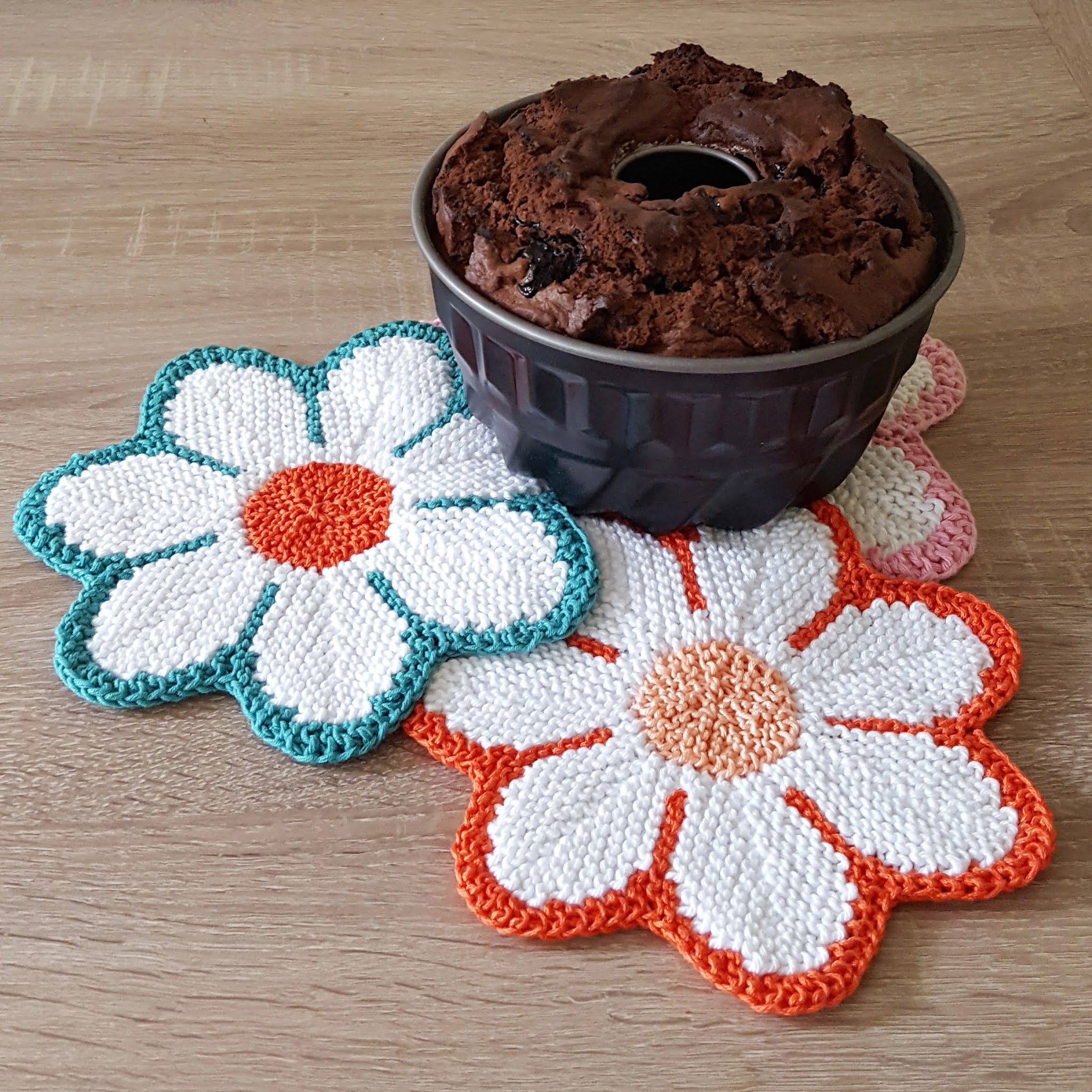
Seven Petals Potholder

After finishing my Daisy Potholders I wanted to knit a flower with a petal contour - and so I started experimenting - and surprisingly enough, it worked.
So, here is the pattern for a flower-shaped potholder, hotpad or coaster. It starts with a provisional CO, is knitted in short row wedges and finished with grafting in garter stitch.
Since this is an intarsia project with three colours that also uses short rows, it can be quite fiddly. It is NOT a beginner pattern.


The pattern is available 

The pattern PDF is 12 pages long and contains
  • written row-by-row instructions for knitting this piece – including four photos of the different stages 
  • a pattern chart of one wedge
  • short photo tutorials for the following techniques
    • provisional CO with a crochet hook and how to undo it
    • grafting in garter stitch
    • short rows with wrap and turn and picking up the wraps 
    • intarsia knitting 
    • weaving in yarn while carrying it (backwards and forwards)
  • photo tutorials and step-by-step explanations of
  • undoing the provisional CO in this pattern (i.e. catching stitches in different colours)
  • grafting this piece – with a decrease and colour changes
Of the 12 pages, the pattern instructions and chart comprise only 3 pages - the rest are the technique tutorials and explanations of their specific application for this motif.

Since it's an intarsia pattern, it looks OK from WS as well (see picture below).


To knit one of these pieces you need the following materials
  • Cotton yarn in three colors – I knitted these potholders in Aran and Sports weight yarn
    • for Aran, I used a total of 30 grams
    • for Sports weight, I used a total of 20 grams
  • knitting needles – straight or circulars: I used 3mm needles for Aran weight yarn and 2.5mm needles for Sports weight yarn, i.e. smaller than the yarn usually requires because I wanted a firm texture. 
  • scrap yarn and a crochet hook (about 3mm) for the provisional CO
  • two tapestry needles for grafting and to weave in ends
The pieces I knitted measure 16 cm to 22 cm in diameter - depending on the yarn weight I used.


Sonntag, 26. Juli 2020

"Darn it!" or Kintsugi

My Cable Experiment Mitts (one of my first ever knitting patterns published back in 2012) were my favorite fingerless gloves to wear - even though they are quite plain and I have knitted far more interesting pairs of fingerless gloves ...

Quite a while ago, I ripped a hole into the upper edge. (In fact, I had to scroll quite far down in my Instagram feed to find out that this happened was in November 2015 - i.e. nearly five years ago).
Back then, somebody pointed me towards the idea of Kintsugi (金継ぎ, "golden joinery") - a Japanese technique to mend broken pottery with gold in way that the crack is still visible, but beautifully so.
Translated to knitting, it meant for me that I wanted to mend it with a beautiful shiny yarn, that would stand out from the dark brown (and cheap) sock yarn that I had used to knit the mitts.
But to mend something like that you really need your concentration and to be in the right state of mind. So I put the ripped mitts safely away ...

This weekend I felt a bit uninspired (or lazy) to continue any of my current knitting projects, so I thought, I might just try to mend these old mitts. First I had to search for them - I had moved house inbetween - so that was OK. Afterwards, I looked for video tutorials on YouTube to teach me the basics of mending knitware. I found this Video by KNIT Freedom and watched it.

Finally, I started the actual mending - using Araucania Botany Lace (here's the yarn's Ravelry page, leftovers from a Hitchhiker scarf I knitted back in 2012). It is fiddly work, especially since I hadn't done this before - and I had to undo bits of it and redo them. I even managed to sew both sides together once :( But in the end it worked, now everything is secure and wearable again.
Here's how it looks ...


Considering that this is the first time, I've ever tried to darn or mend a piece of knitted fabric, I'm quite happy - even though I had hoped it would turn out a bit neater.
And I'm even tempted to make the patch a bit bigger or to put some more embroidery on the upper edge of the piece, because I really like the contrast of the two yarns.